Unlocking Durability and Color: The Ultimate Guide to Anodized Titanium
In the world of advanced materials, anodized titanium stands out as a unique solution that combines aesthetic brilliance with functional superiority. Unlike standard surface treatments, anodizing modifies the titanium surface itself, creating a protective oxide layer that enhances performance in aerospace, medical, and industrial environments.
As a leading global supplier, Ti Time Company specializes in the customized manufacturing of high-grade titanium products. Whether you need raw material for processing or finished anodized titanium components like screws and fasteners, our ISO9001-certified processes ensure precision and reliability for the US, German, and Asian markets.
II. What is Anodized Titanium and How Does It Work?
Anodized titanium is not painted or dyed. It is the result of an electrochemical process where the natural oxide film on the metal’s surface is artificially thickened. By adjusting the voltage in an electrolytic bath, we can precisely control the thickness of this titanium-oxide (TiO₂) layer.
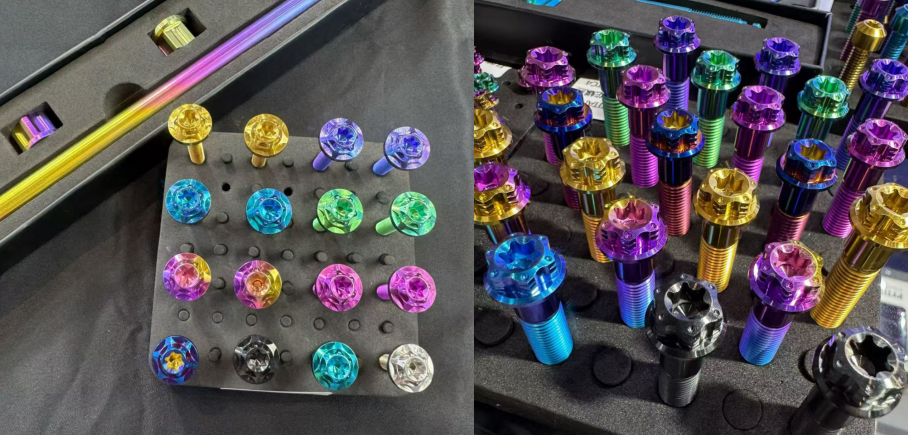
Interference Coloring: The vibrant colors (blue, gold, purple, green) are created by light interference, similar to oil on water. This means the color is integral to the surface and will not chip like paint.
Enhanced Protection: This thickened oxide layer acts as a barrier, significantly increasing the metal’s corrosion resistance against moisture, chlorides, and harsh chemicals.
Anti-Galling: In mechanical applications, untreated titanium can “seize” or gall against other metals. Anodizing hardens the surface, reducing friction and wear in moving parts.
III. Types of Anodizing: From Aerospace to Medical
Understanding the different types of anodized titanium is crucial for selecting the right finish for your project. Ti Time Company supports clients in navigating these specifications.
Type II (Grey Anodizing): This is a thicker, darker coating designed primarily for wear resistance. It is the standard for aerospace components where anti-galling properties are more important than aesthetics.
Type III (Color Anodizing): This process focuses on creating specific interference colors. It is widely used in the medical industry for color-coding surgical implants (e.g., distinguishing screw sizes by color) and in consumer goods for decorative finishes.
IV. Critical Applications of Anodized Titanium
The unique properties of anodized titanium make it indispensable across high-tech sectors:
Medical & Dental: Titanium is biocompatible. Anodizing creates a passive surface that is safe for internal implants and helps surgeons quickly identify different tool sizes via color coding.
Aerospace: High-strength fasteners and airframe components undergo Type II anodizing to prevent fatigue and corrosion at high altitudes.
Marine & Industrial: For subsea valves or oilfield equipment, the enhanced oxide layer provides a critical shield against saltwater corrosion, extending the part’s service life.
V. FAQ: Expert Insights on Anodized Titanium
Q1: Does the color on anodized titanium fade over time? A: Since the color comes from light interference rather than pigment, it is very stable and UV resistant. However, heavy abrasion or harsh acidic cleaning can wear down the oxide layer, causing the color to shift or fade.
Q2: Does anodizing change the dimensions of the part? A: The dimensional change is microscopic—typically only tens of nanometers for color anodizing (Type III) and slightly more for Type II. For most precision applications, this growth is negligible and does not affect tolerances.
Q3: Can Ti Time Company supply anodized fasteners? A: Yes. We offer customized manufacturing of titanium screws, bolts, and fasteners in various grades (Grade 2, Grade 5) and can provide them with anodized finishes for color-coding or enhanced wear resistance.
Q4: Is anodized titanium electrically conductive? A: The oxide layer is electrically insulating (dielectric). This is beneficial for reducing galvanic corrosion when titanium is mated with dissimilar metals like aluminum or steel.
Q5: How does the raw material cost affect the final price? A: The base cost is driven by the titanium billet price. While anodizing is a relatively low-cost finishing step, the grade of titanium (e.g., CP Grade 2 vs. Ti-6Al-4V) and the machining complexity are the primary cost drivers.
VI. Ti Time Company: Your Global Partner for Advanced Materials
Ti Time Company is a leading manufacturer and supplier specializing in titanium, tungsten, molybdenum, tantalum, niobium, zirconium, anodes, and composite materials. With decades of experience, we are known for delivering high-quality products and exceptional customer service.
Our offerings include plates, rods, tubes, foils, wires, screws, capillary tubes, targets, custom parts, forgings, and alloys. Operating under the ISO9001 quality system, our products meet ASTM, ASME, AMS, JIS, DIN, and MIL standards, and are exported to countries such as the US, Japan, Germany, and South Korea.