The Future of High-Temperature Engineering: A Guide to Titanium Aluminide
As aerospace and automotive industries push the limits of performance in 2026, titanium aluminide (TiAl) has emerged as a critical intermetallic material for next-generation designs. At Ti Time Company, we leverage decades of expertise to provide high-quality titanium aluminide solutions that bridge the gap between conventional titanium alloys and heavy nickel-based superalloys. Whether you require standard grades or custom-fabricated components, our mission is to deliver materials that thrive under extreme thermal and mechanical stress.
Unlocking the Benefits of Titanium Aluminide
Titanium aluminide is not just an alloy; it is a family of intermetallic compounds—primarily $\gamma$-TiAl and $\alpha_2$-Ti$_3$Al—that offer a unique combination of lightness and heat resistance. For engineers looking to reduce rotating mass without sacrificing structural integrity at high temperatures, TiAl is the gold standard.
Exceptional Lightweighting: With a density of only 3.8–4.2 g/cm³, it is roughly half the weight of nickel-based superalloys while maintaining comparable strength.
High-Temperature Stability: Many $\gamma$-TiAl alloys retain their stiffness and creep resistance at operating temperatures between 700°C and 1,000°C.
Oxidation Resistance: The chemistry of the material allows for a stable protective layer, making it ideal for the harsh environments of jet engines and high-performance turbochargers.
Custom Manufacturing of Titanium Aluminide Components
At Ti Time Company, we understand that every project has unique requirements. We specialize in the customized production of advanced materials to meet the specific needs of our global clientele. Operating under the ISO9001 quality system, our manufacturing processes ensure that every part meets rigorous international standards, including ASTM, AMS, and MIL.
Our Capabilities Include:
Advanced Alloys: Supply of specialized powders like Ti-48Al-2Cr-2Nb for additive manufacturing.
Precision Forging & Machining: Handling the inherent brittleness of intermetallics with expert care to produce high-integrity engine blades and valves.
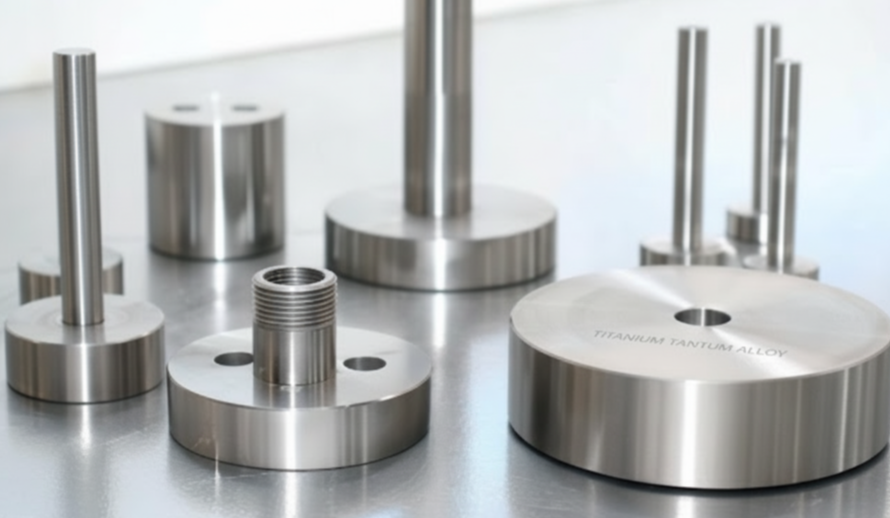
Diverse Product Forms: From targets and rods to complex custom-machined parts.
Global Logistics: Reliable export to high-tech hubs in the US, Japan, Germany, and South Korea.
FAQs: Expert Insights on Titanium Aluminide
1. Why is titanium aluminide preferred over nickel superalloys in modern engines?
The primary driver is weight reduction. By replacing heavier nickel components with titanium aluminide in low-pressure turbine blades, engineers can reduce the overall weight of an aircraft engine by hundreds of pounds. This directly translates to better fuel efficiency and lower emissions.
2. What are the main challenges when working with $\gamma$-TiAl?
While it is incredibly strong at high temperatures, titanium aluminide has lower room-temperature ductility than standard titanium. This makes it more sensitive to fractures during the machining and assembly phases. At Ti Time Company, we use specialized processing techniques to mitigate these risks and ensure component longevity.
3. Can Ti Time Company produce custom TiAl parts via Additive Manufacturing?
Yes. We provide high-purity titanium aluminide powders specifically optimized for 3D printing (Selective Laser Melting or Electron Beam Melting). This allows for the creation of complex cooling channels and geometries that are impossible to achieve through traditional casting.
4. What is the typical temperature range for titanium aluminide applications?
Standard structural applications usually operate in the 650°C to 850°C range. However, advanced grades customized with elements like Niobium (Nb) can push performance limits toward 1,000°C for short-duration or specialized aerospace missions.
5. How does Ti Time Company guarantee the quality of its intermetallic products?
Quality is our cornerstone. We provide full material traceability and Certificate of Analysis (CoA) for every shipment. Our testing includes chemical composition verification and mechanical testing to ensure the material performs exactly as specified in your design.